
Mito – thread chondrion – granule
- These are rod shaped structures,
- function as power generators of cell as they convert nutrient and oxygen in to ATP
- It is chemical energy which is essential to carry out the metabolic process of cell.
Ultrastructure of Mitochondria
The structure of mitochondria Divided into following part-
- Mitochondrial membrane
- Mitochondrial chamber
- Mitochondrial Cristae
- Elementary Body / Particle
- Mitochondrial DNA
- Mitochondrial RNA
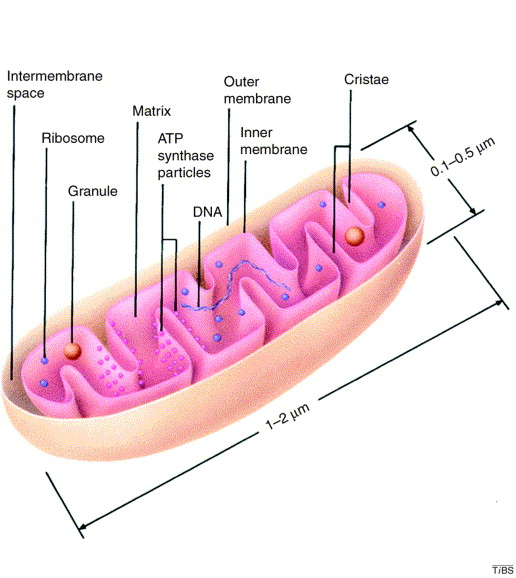
1- Mitochondrial Membrane
- These are bounded by double-layered lipoprotein membranes .
- Each of which is 60 to 70A० Thick
These are divided into two parts.
1. Outer mitochondrial membrane-
- It separates the mitochondria to cytoplasm.
- It is permeable for electrolytes, water sucrose and large molecules.
- At some places it is found attached with E.R.
- It contain high amount of lipid (40%)
- It contain pore (Some time -25-30A⁰)
- In this cholesterol & Phospholipid, inositol are also present in high amounts.
2.Inner mitochondrial membrane
- It is thick (~50-70A⁰)
- It makes finger-like projections into the inner chamber which are called cristae.
- It is impermeable to ions, sucrose etc.
2- Mitochondrial Chamber
1. Outer Chamber
- Iti is the space between outer and inner membrane.
- It is 60-80A⁰ wide
- It is filled with a liquid which has low density and viscosity.
- It is called peri mitochondrial space.
2.Inner chamber
- It is an inner part of inner membrane
- It is divided into incomplete but continuous chambers due to infolding of the membrane.
- It is filled with a homogeneous granular mitochondrial matrix.
- These granules are 800-500A⁰ in size
- It also contains 70s Ribosomes, mtDNA, inorganic salts and polymer of sugars etc
- The inner membrane which is toward the matrix is known as M-side, while the side which is facing the outer chamber is known as C-side.
- Enzymes of the krebs cycle are present in the matrix.
3- Mitochondrial Cristae
- The inner membrane of mitochondria is folded inside and form plate like structure which is called cristae.
- It is attached to the matrix.
- It is also called mitoplast.
- The outer side of cristae called C-face and Inner side which toward the matrix is called M-face.
- It is two type
- Tubular /Microvilli – It is abundantly present in plant mitochondria.
- Plate Like – It is present in Animal mitochondria, It is also present in the form of sollensac, regular plate, vesicles and tubules.
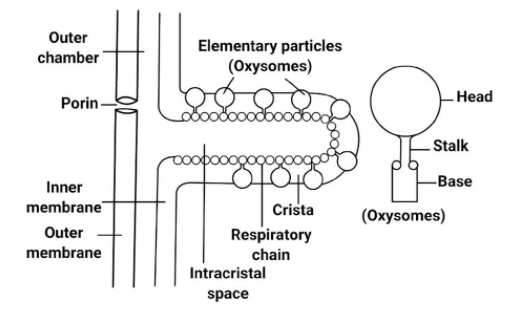
4- Elementary particle / Granule/ Oxysome – H.F. moran
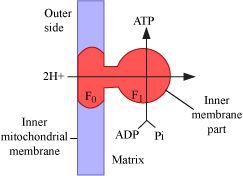
- The M-side of inner membrane contains many stalk particles like structure which is called as elementary particle, oxysome, F0 complex, ATPase complex, F1 Particle etc.
- Mitochondria have 10000 to 100000 oxysome which are set a distance of 10nm and comprise about 15% of total inner membrane protein part.
- The size of F1 Particle is 80 -100A⁰ or 8.5 nm diameter.
- It is divided into following part
- 1- Head – 75 -100A⁰ diameter
- 2- Stalk – 30-40A⁰ diameter 40-50A⁰ long
- 3- Base – 40X100A⁰
- The Basal part is attached to membrane, it contain enzyme for ETC or respiratory chain while head part contain ATPase enzyme, ATP synthase or coupling factor, ATP synthase part in oxidation and phosphorylation.
- Oxysome contain 4 enzyme complex
- I and II complex – Base
- III complex – Stalk
- IV complex – Head
Mitochondrial DNA /Genome
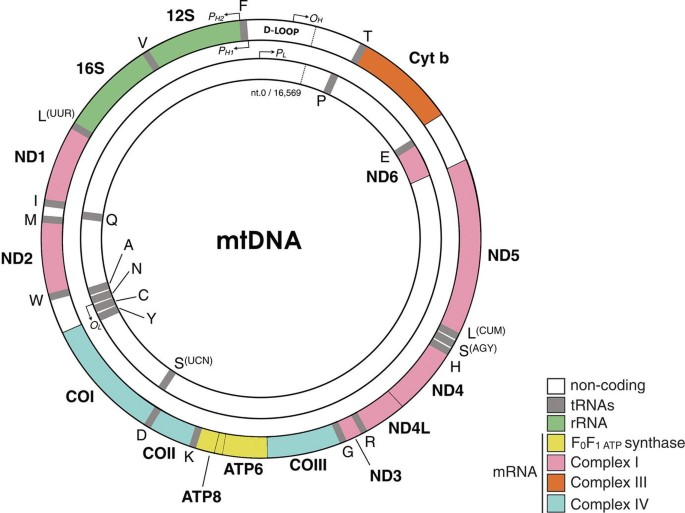
- One or more DNA (2-6) can present in mitochondrial Matrix
- Size- 6µ Long
- Animal – Small – 16-19kb
- Yeast and Plant – Large- 100-200kb
- Human – m-DNA – 16579 bp – Introns Absent –13 protein code
- Yeast – 78000 bp-Intron +nt
- Smallest mt – genome /DNA- Plasmodium falciparum – 6kb – code only 3 protein
- It is Circular, dsDNA, and Supercoiled
- Self Replicate
- High G+C content
- MW- 9-11X106
- Origin – G2 Phase
- It encode – rRNA and tRNA and 20 types of Proteins
- No to attach – Histone protein
- Its DNA pol is different to N-DNA Pol
Mitochondrial RNA
- These are different to cytoplasmic RNA
- In this – 23s 16s, 4s types of RNA are present
- These are resistant to Ribo-nuclease enzyme
- Mitochondria have 70s types of Ribosome
- In it Protein synthesis can be inhibited by Chloramphenicol
Functions of Mitochondria
- The main function of mitochondria is to perform cellular respiration to produce energy. It carries out oxidation of food using oxygen and produces energy which is used to form or produce ATP (the energy currency of cells) through cellular respiration, a process in which it takes in nutrients from the cell and converts them into energy, which is used by the cell to perform various functions.
- It also converts food or nutrients into molecules such as proteins, carbohydrates, etc.
- It also eliminates wastes from the cells. The mitochondria in liver cells have enzymes that detoxify ammonia.
- It causes cytoplasmic inheritance as the mitochondrial DNA passes from the egg’s cytoplasm to the zygote during the fertilization of egg and sperm.
- It is the site where the citric acid cycle or Krebs cycle occurs.
- It maintains calcium homeostasis or the concentration of calcium ions in the cell. For example, calcium flow in and out of mitochondria which is known as mitochondrial calcium exchange and thus it helps in metabolic regulation and apoptosis (programmed cell death) of old or damaged cells.
- It releases proteins like cytochrome c in response to various types of cell stress such as heat, infection, calcium and nutrient deficiency.
- It also aids in making certain parts of blood and hormones such as estrogen and testosterone.
- It can perform thermogenesis or production of heat through proton leak.
- It helps in the growth and multiplication of cells. For example, when an organ is under stress while performing a specific task, mitochondria can multiply to help the organ.
- It also helps in the synthesis of the heme (iron-containing part) part of hemoglobin and myoglobin.